In 1939, the editorial in the BGS School Magazine said: "November 11th will be a sad, ironic day this year. Once more the names of Old Boys who fell in the last war will be remembered and of the School, who knows but that another list of names that we know now, will be added to the tally." (Vol XLII Nov 1939).
A total of 2332 Old Boys would serve in World War II, and 252 names would be added to the tally of those who fell. Of that total, 168 served in the Air Force, 78 in the Army and 10 in the Navy. 101 died in Europe, 90 in the Asia-Pacific, 31 in the Middle East and Mediterranean and the remainder in Australia. In paying tribute, we recount just a few of their stories.
In Europe, Spitfire pilot Gordon Olive '31 flew cover during the evacuation at Dunkirk, before making 193 sorties during the Battle of Britain and beyond. He won the Distinguished Flying Cross (DFC) in 1940.
Most Old Boys flew in the RAAF or Britain's RAF in bombing raids. Thomas Dimmock (1921) and his brother Harold (1912) both served in 12 Squadron (RAF). Harold died in an air battle over Belgium on 3 June 1942. He was still listed as missing at the time Thomas died over Germany on 12 January 1943. Frederick Deshon '34 and James Kydd '32 were among six crew members all killed when their Wellington Bomber crashed on 21 January 1944. Ten years earlier, Deshon was a School Prefect and captain of the First XI.
William Barbour '38 worked for the Bank of New South Wales. He was shot down off the Frisian Islands in 1944, aged 21. His cousin, Kent Watkins '39, was a few weeks away from turning 21 when he was shot down over Italy, also in 1944.
In North Africa, John Lavarack (1904) commanded units that were successful in repelling Field Marshal Rommel's forces at the Siege of Tobruk. Eleven Old Boys are buried in cemeteries in Libya, Tunisia and Egypt.
Australian troops were recalled from the Middle East to fight in the Pacific. John F Jackson (1923) served with 3 Squadron (RAAF), winning a DFC for action in North Africa and was later killed during an air battle in Papua New Guinea on 28 April 1942. Jackson International Airport in Port Moresby honours him.
Singapore fell in 1942 and the 2/10th Field Regiment surrendered its garrison on 15 February. James Browne (1925), Jack Ewing (1928), Kenneth Gray '34, John Hibbard '34, Richard Leslie (1926) and John Norbury (1928), all in the 2/10th, and Leonard Phillips (1922), in the 2/26th Battalion, became prisoners of the Japanese. All died during the construction of the Thai-Burma railway. James Heaslop '31, Clive Greenup (1927) and Hugh Ovens '37, in the 2/10th, and Eldred Strout (1925) in the 2/26th all died in the Sandakan POW camp in North Borneo, on the death marches inland or in Ranau prison.
At sea, Ross Cole '31 was killed in 1940 when the steam merchant ship Tregenna was sunk by U-Boat 65 near the outcrop Rockall in the North Atlantic. Albert Byrne '34, Thomas Clark '33, Laurence Ogilvie '30 and Robert Rees '32 were all killed when HMAS Sydney II was destroyed by the German cruiser Kormoran on 19 November 1941. Garth Aitchison '35, John Kerr '37 and Charles Thelander '30 were all killed on the Australian Hospital Ship Centaur when it was sunk by a Japanese submarine south of Moreton Island.
John Avery '31 was killed in Papua in 1943 fighting with the 2/9th Battalion. His father, John (1900), served in Egypt, France and England during WWI. His uncle, Reginald (1896), was killed in Bouzincourt in 1918 stemming the German advances toward Amiens. His other uncle, Wilfred (1903), was killed at Hill 60 in Belgium in 1917. The Year 11 prizes for Chemistry and Physics are named in his honour.
Darwin continued to be bombed in 1943. Alexander McNab was killed in a flying battle that year. His cousin David Tait was killed in a flying battle in New Guinea in 1944. Both left BGS in 1931.
The 1945 magazine editorial read: "Peace! Its enchanting note rings the whole world round… A new task lies before us - that of remoulding from the chaos a civilisation for surpassing the old." (Vol XLVIII Nov 1945).
A database containing school and service records of all BGS Old Boys who died in war is accessible in the history section of the BGS website.
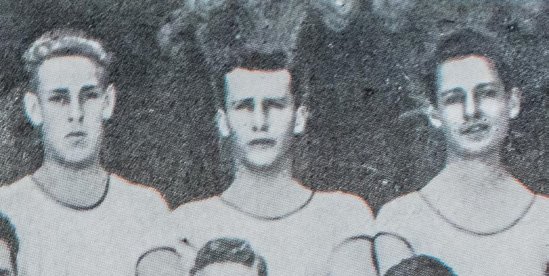
Named in the photo captions (all Old Boys): - Adolf Hoffman (standing) and David Bell, the BGS Athletic champions 1937. Bell served in the Engineering Corp. Hoffman and his Lancaster crew were shot down in 1944. All died. - Members of the 1931 Athletics team: John Krefter was killed over Germany in 1945, James Heaslop in Sandakan and Kenneth Currie in New Guinea in 1943. - The entire 1935 First Crew served in the war. Frederick Smith (standing right) was executed by the Japanese in 1944. Sydney White (seated right) was killed in an air crash in Colombo in 1942. - Bill Heywood flew with 466 Squadron and was shot down in France. (Photo taken in 1936.)
Source: Grammar News Summer 2021. Read the original edition