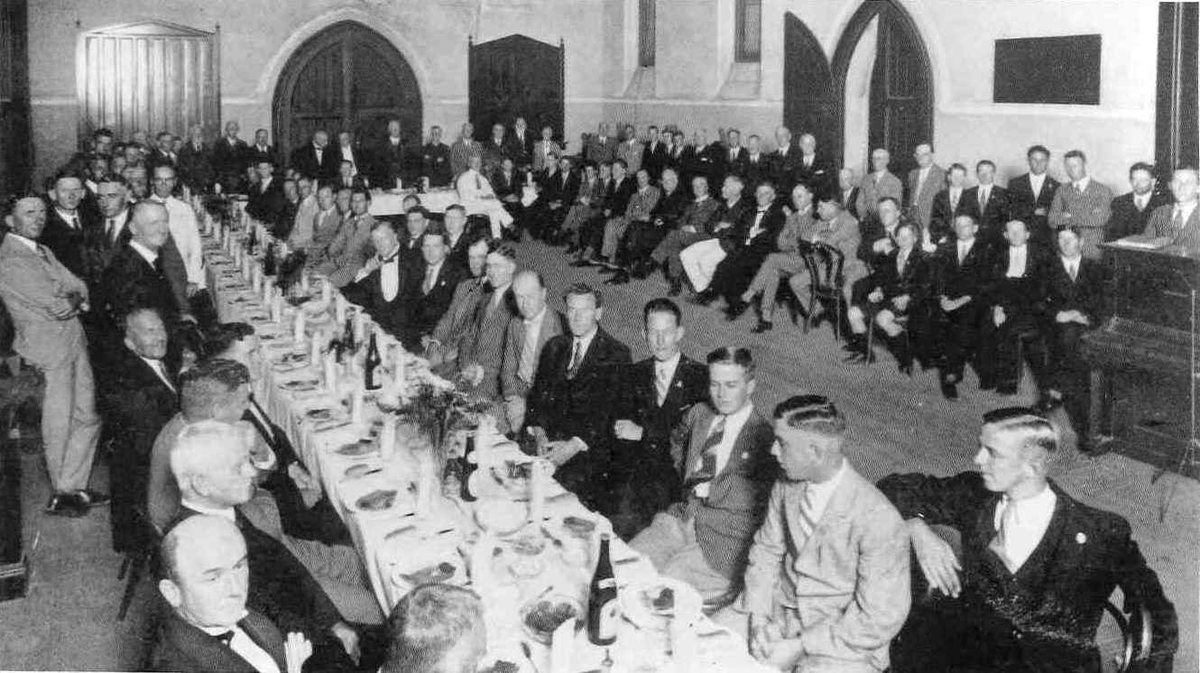
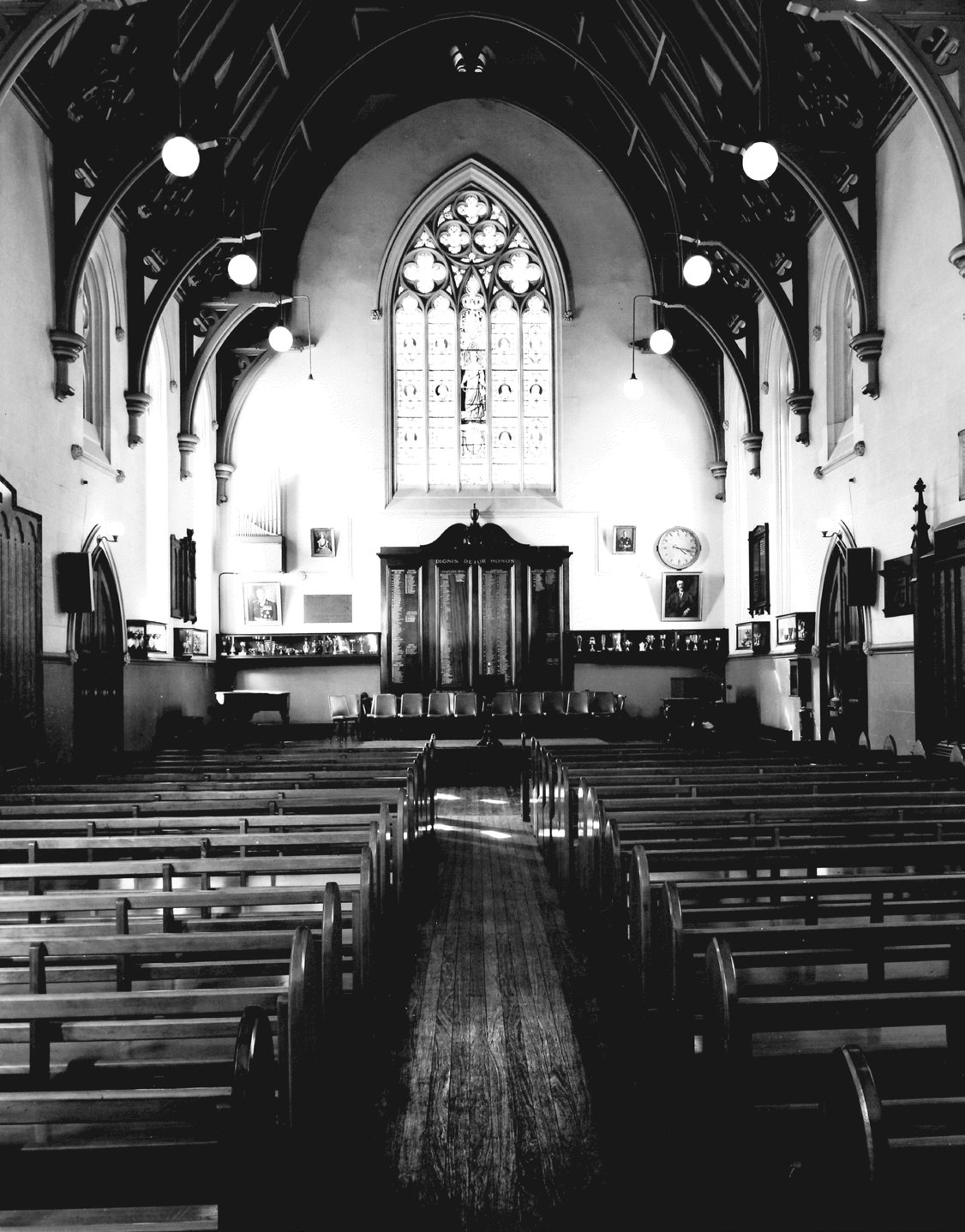
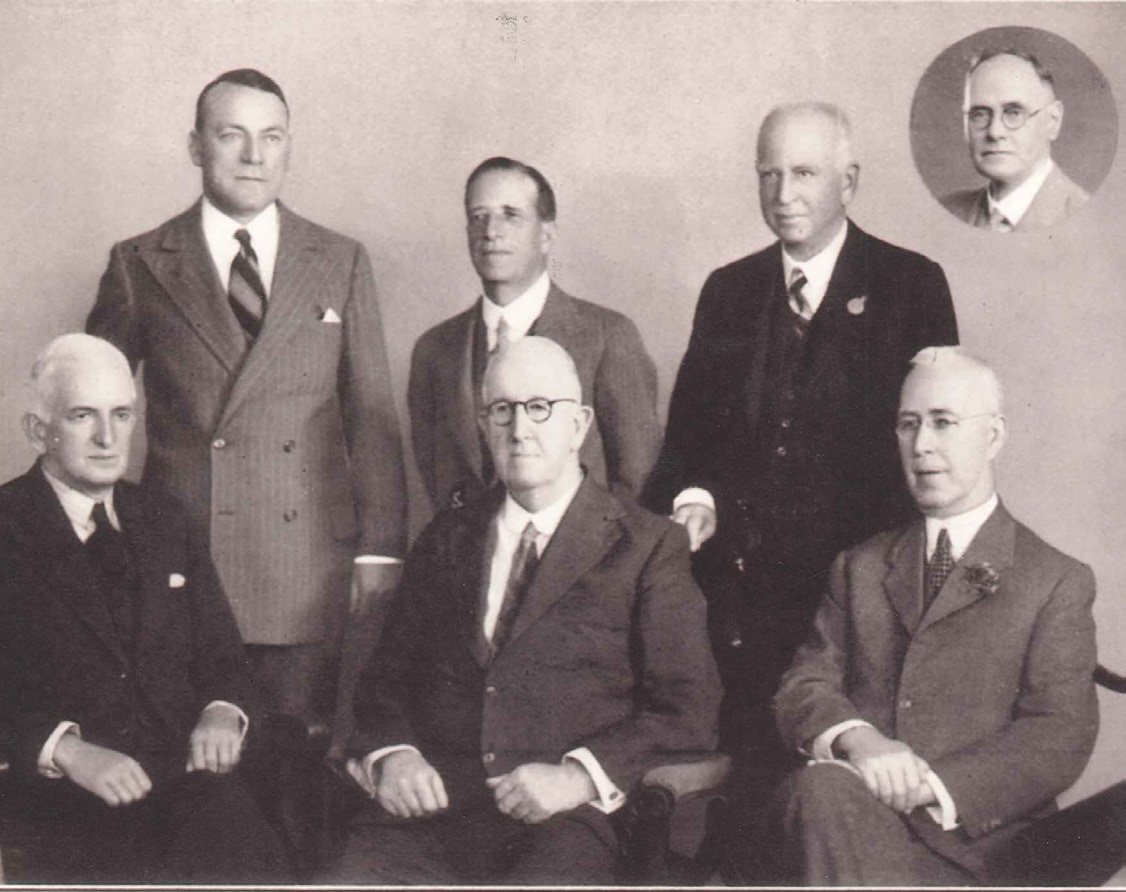
BGSOBA Foundation Day dinner in the Great Hall, 29 February 1932.From the archive
The Brisbane Grammar School Old Boys' Association was one of the first to be established in an independent boys' school in Queensland.
In 1884 a small society of Old Boys called the 'Reunion' was formed which operated for two years. However, it was not until 1 June 1898 that the present body, the Brisbane Grammar School Old Boys' Association (BGSOBA) was formed with the Headmaster, Reginald Heber Roe, appointed its first president.
Three sub-committees were appointed: Amusements (to prepare the program of meetings and arrange for annual reunions); Sports (to organise clubs for outdoor sports); Education (to promote 'intellectual pursuits' among members).
The first ordinary meeting was held at the fashionable Café Eschenhagen in Queen Street on Wednesday 27 July 1898. The draft of the BGSOBA Constitution and Rules was finally settled with between 40 and 50 of the 200 members in attendance.
At its inception the BGSOBA decided to establish a fund for presenting prizes for school work and sports.
Despite an enthusiastic membership the association had financial troubles when a fire destroyed its premises and property in 1909.
The BGSOBA was reinvigorated when John Gabriel Nowlan took over as secretary and treasurer in 1910 – the year he joined the School as an Assistant Master. His belief that every boy leaving the School should join the BGSOBA saw membership increase to 1000 by 1922.
Over the years, the BGSOBA has helped to finance many school projects and funds bursaries which are presented on Foundation Day.
In July 1920 the School Jubilee celebrations were represented by a committee representing the BGSOBA and the War Memorial Committee.
Raising funds for the War Memorial Library was carried out largely by the BGSOBA, with past student Charles Bennet Fox writing 'The Golden Book' entries of Old Boy veterans of the Great War.
In 1938 the association formed an appointments board to help past and present pupils find suitable jobs to counter the effects the Great Depression had on them finding employment.
In the postwar years the BGSOBA contributed funding to memorial projects such as the World War II Honour Board in the Great Hall, unveiled in 1949, and the gymnasium and swimming pool which opened in 1953 and 1954 respectively.
More recently the association has assisted with appeals associated with the Centenary Building Fund in 1964 and the Lilley Centre which opened in 2010. The bridge linking the main campus with the M.A. Howell Sports Centre was officially named The Old Boys' Bridge in recognition of the BGSOBA's financial contribution to the School's structures.
From its humble beginnings the BGSOBA's membership has grown to some 2000 life members.
As a custodian of the School's traditions, which includes the annual Old Boys' Reunion Dinner, the BGSOBA encourages fellowship between different generations of Old Boys and how they can serve the School community.
A note on names. This fact sheet was published by the Brisbane Grammar School Archives in 2014 and is reproduced here as it was written. It refers to the M.A. Howell Sports Centre. That building is now the Indoor Sports Centre. The sheet has not been altered.
Reproduced in full from The Brisbane Courier of Monday 12 February 1900, page 7, held by the National Library of Australia. Out of copyright. The article is the earliest contemporaneous press account of the Old Boys' Association that the Association holds.
BRISBANE GRAMMAR SCHOOL OLD BOYS' ASSOCIATION.
OPENING OF THE NEW CLUBROOMS.
Saturday night last was chosen by the Old Boys' Association of the Brisbane Grammar School for the opening of their new clubrooms, the event being marked by the informality which the association is striving to make the rule of their club.
There was a full attendance of the members, including Mr. J. Woolcock (the president of the association), Mr. R. H. Roe, Mr. Lewis A. Bernays, and most of the present masters of the school.
Shortly after 8 Mr. Woolcock, in a brief speech, welcomed the old boys to their permanent quarters. He pointed out the advantages accruing from the possession of a regular resort for the members, and outlined the principal rules which would be in force for the management of the rooms.
After thus declaring the rooms open and installing the members, as it were, Mr. Woolcock turned his attention to their amusement, Messrs. P. O'Shea, H. Rutledge, G. W. Power, J. Oxenham, T. P. Power, M. Campbell, and Quinnell being all requisitioned for the service. Needless to say, they threw themselves into the task of entertaining their fellow-clubites, and the evening passed quickly in a most acceptable and agreeable manner.
The function proper was supposed to end at 9 o'clock, but there was really no interval until 11, the members, after a light supper supplied by Mrs. Young, of the Ascot Tea Rooms, settling down to billiards, cards, conversation, and general harmony.
The new rooms in the London Chartered Bank Chambers are two in number, with the usual retiring-rooms and lavatories. The larger one is to be devoted to general recreation, its commodious nature eminently fitted for the purpose. In it there is a very fine and well-lighted billiard table, a piano, a goodly number of easy chairs, and so on. The smaller room is, primarily, a reading-room, where the latest magazines, from the frivolous down through the general to the serious, have been supplied.
As Mr. Woolcock pointed out in his speech, the rooms would be much more comfortable when the newness had worn off, but at all events the Brisbane Grammar School Old Boys' Association are to be congratulated upon their acquisition of a lasting habitation.
A note on this transcription. The article was scanned and machine-read by the National Library of Australia. Characters garbled in that process have been corrected against sense, and no correction changes the meaning: "Wooleock" to "Woolcock", "Bet^nays" to "Bernays", "thejtosk" to "the task", "looms" to "rooms", "retiring-rocms" to "retiring-rooms", "¡Mast-ing habitation" to "a lasting habitation". The word "clubites" is retained as printed. The spelling "Quinnell" is as machine-read and unverified.
Source:The Brisbane Courier (Qld. : 1864–1933), Monday 12 February 1900, page 7. Via Trove, National Library of Australia: http://nla.gov.au/nla.news-article19082492
Brisbane Grammar School Archives, no year printed · ↑ Top
Field Gun
trophies of war
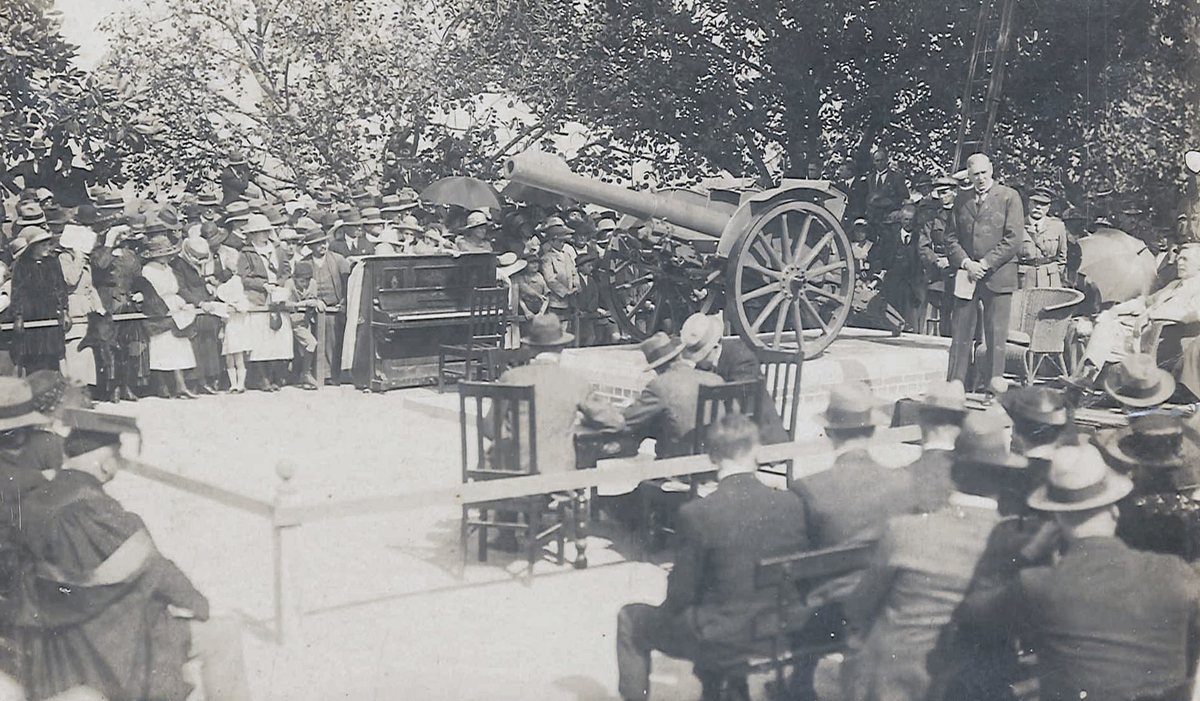
Dedication of the gun by the Governor General of Australia, Lord Forster, on 11 August 1921.From the archive
One of the School's most affectionately regarded icons – the gun outside the Great Hall – was captured by a renowned Old Boy in the dying days of the Great War.
This Austrian-made Skoda 10.4 field artillery gun was manufactured in 1917 and pressed into service by the Turkish Army in Palestine where it was captured.
On 20 September 1918, Brigadier-General Lachlan Wilson, an Old Boy of the School, in command of the 3rd Light Horse Brigade, along with Lieutenant Hammond and Trooper Higgins, captured the field gun and 40 Turkish soldiers on the outskirts of Jenin.
The 3rd Light Horse Brigade was part of a cavalry offensive that succeeded in capturing the town at an important stage of the conquest of Palestine in the war with Turkey.
Originally the gun was to be sent as a war trophy to Bombay. However, Brigadier-General Wilson's application, combined with the aid of another distinguished Old Boy, Lieutenant Colonel Donald Charles Cameron, and Alderman J.F. Maxwell, ensured the gun was allotted to the School.
The presentation was made by the Australian War Trophies Commission to commemorate the distinguished service of the School's Old Boys in the Great War.
The gun was placed on a pedestal in the centre of the School's main driveway.
The bronze plaque on the plinth is inscribed:
THIS GUN – WITH 8,107 TURKS AND GERMANS – WAS CAPTURED AT JENIN, PALESTINE, ON THE 20TH SEPTEMBER 1918, BY BRIGADIER-GENERAL L.C. WILSON C.B. C.M.G. D.S.O. CROIX DE G, 3RD LIGHT HORSE BRIGADE, A.I.F. AN "OLD BOY" OF THIS SCHOOL
The gun was officially unveiled by the Governor of Australia, Lord Forster, on 11 August 1921. Student cadets formed a guard of honour, flags adorned the grounds and entry arch for the vice regal party, the HMAS Melbourne band provided the music, and the event concluded with the 'The Last Post' and the assembly singing the Doxology.
In 1993 the gun was removed from the grounds to be restored. Much of the work for this joint initiative of the School and Old Boys' Association was carried out by tradesmen and apprentices of the Australian Army's South Queensland Logistics Group.
The gun was returned to the School on Foundation Day, 23 February 1996 and placed closer to the Great Hall where it stands as a tangible reminder of the bravery and sacrifices made by Old Boy veterans of the First World War.
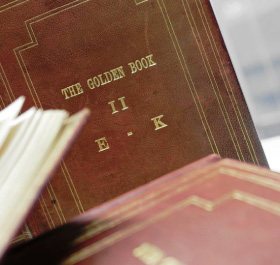
One of the four volumes of The Golden Book.From the archive
A book of national significance that has pride of place in the School collection provides an insight into the Old Boys who volunteered for service in the Great War.
This is 'The Golden Book', produced in 1924 and comprising information about each of the 1020 Old Boy veterans listed on its pages.
There is a page devoted to each of them, listed alphabetically, including details of School enrolment and achievement, occupation and war service. The names of those omitted were later included on the nearest blank page.
'The Golden Book' was a labour of love.
It was compiled by Stuart Stephenson, Second Master at the time who later served as Headmaster from 1928-1940.
The calligraphy was the work of Charles Bennett Fox, a pupil at the School from 1875-1879 and Trustee from 1922-1939. He was a co-donor with E. Austin Bell of the War Memorial Library's beautiful Fortitudo window, symbolising fortitude.
The interlacing border of stencilled poppies on every page was designed by Madge Roe, daughter of Reginald Heber Roe, Headmaster from 1876-1909.
The four volumes were bound in brown calf leather with each gilt-edged page lined at the sewn join with pale blue silk.
The foreword was written and signed by the Governor of Queensland, Sir Matthew Nathan, which he dated 11 November 1924. This was Armistice Day which marked the opening of the War Memorial Library, where 'The Golden Book' was given pride of place.
He said that 'The Golden Book', 'containing the records in manuscript, of all those who went to the war, will be a central feature of the library and its most treasured volume'.
On Open Day each year the School pays homage to Old Boy veterans of the Great War by relocating 'The Golden Book' from the Brisbane Grammar School Archives to the War Memorial Library where it can be appreciated by all those who enter the building.
The War Memorial Library was built to honour the School's Old Boys who served in the First World War, especially those who died in the conflict.
Justice John Laskey Woolcock, as Chairman of the School War Memorial Committee, was instrumental in ensuring that a library would be the most appropriate memorial to these Old Boys.
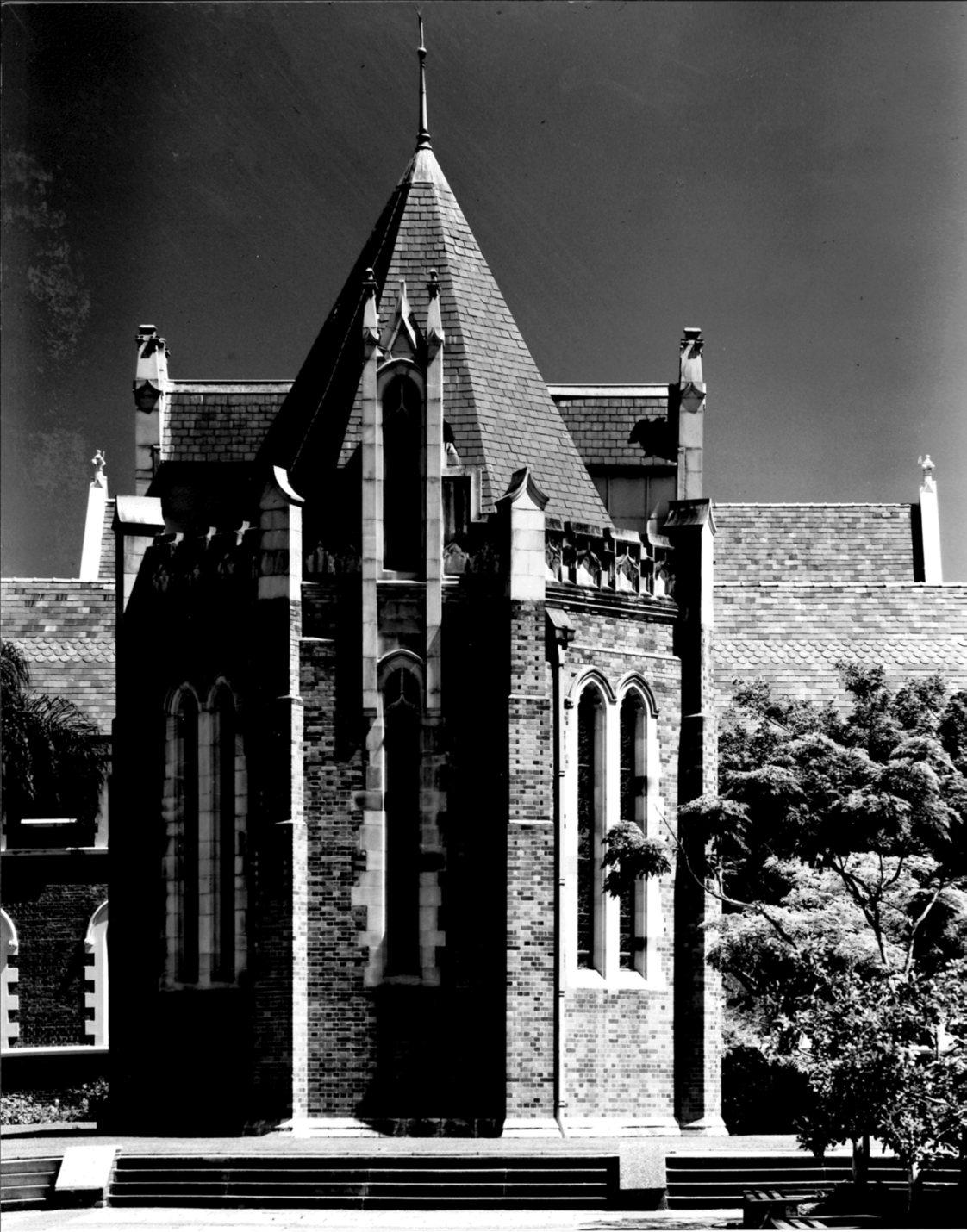
The building's foundation stone was laid by the Governor of Queensland Sir Matthew Nathan on Anzac Day 1923. Material placed underneath included items that had been beneath the foundation stone of the original School at Roma Street.
The War Memorial Library was formally opened with a golden key by Sir Matthew Nathan on Armistice Day, 11 November 1924.
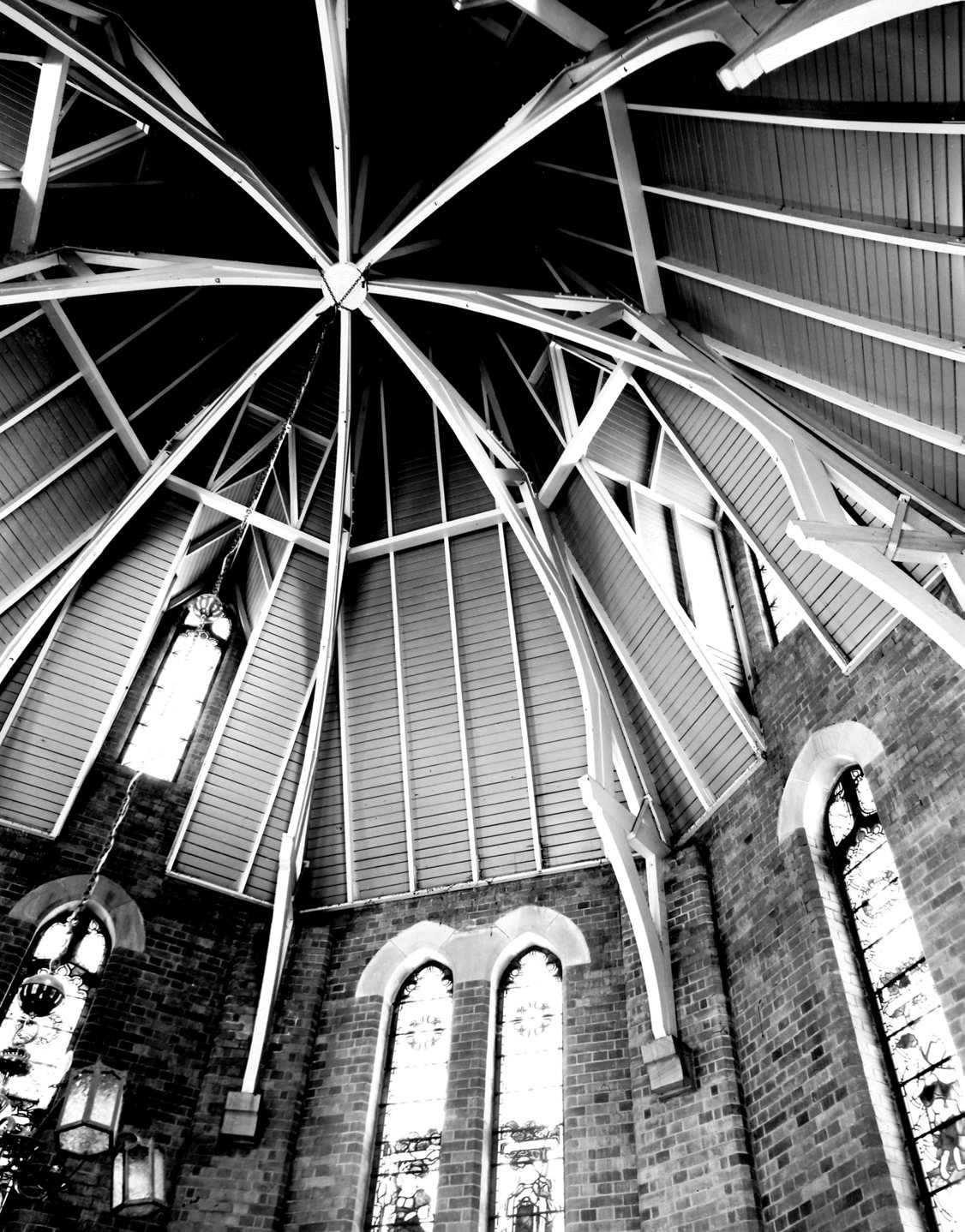
This octagonal-shaped building in the Gothic Revival style was designed by a past student, architect John Barr. The 12 stained-glass windows and much of the furniture were designed by Charles Tute, a stained-glass artist and cabinet maker.
The entrances to the building are under the windows Victoria (Victory) and Pax (Peace). Inside are plaques on either side of the main entrance listing the names of Old Boys who made the ultimate sacrifice.
The library was to house reference books as well as The Golden Book. This four-volume, hand-written record of the 1020 Old Boy veterans of the First World War was produced in 1924. Books and memorabilia were donated to the library, making it the shrine of memories that the School community wanted.
By the late 1960s the building could no longer accommodate the School's growing collection of books. It was converted into a museum when the Centenary Library opened in 1969.
The War Memorial Library showcases artefacts and memorabilia about the School's history and is opened for special events such as Open Day.
Ceiling of the War Memorial Library, 1999.From the archive
The magnificent stained-glass windows are dedicated to the memory of Old Boys who died in the Great War.
They were designed by Charles Tute, based on suggestions by War Memorial Library architect John Barr.
The 12 windows represent the chivalrous qualities considered to be worthy goals for the boys of the School. Clockwise from the northern end of the building they represent Pax (Peace) over the main entrance; Aequitas (Justice); Magnanimitas (Magnanimity); Humanitas (Courtesy); Honestas (Honour); Officium (Service); Victoria (Victory) over the southern entry; Fortitudo (Fortitude); Reverentia (Reverence); Fides (Loyalty); Pietas (Duty); and Veritas (Truth).
The former library, now a museum, has many items of historical significance. This includes the four volumes of 'The Golden Book', produced in 1924, a hand-written record of the 1020 Old Boys who volunteered for service during the Great War. The names of the 176 who made the ultimate sacrifice appear on plaques either side of the main entrance.
This book is of national significance and is kept in the Brisbane Grammar School Archives when not on display.
Above the south entry is the mounted propeller from Old Boy Cedric Hill's Tiger Moth with a photograph of him inserted into its centre. The plane crashed in 1930 when he tried to beat Bert Hinkler's time for a solo flight to Australia.
In a daring exploit in 1918 Hill collaborated with a fellow prisoner-of-war to escape from the clutches of the Turks after two years in captivity by feigning insanity. During the Second World War he had operational commands in Britain and the Middle East.
On 31 March 2021 the Royal Australian Air Force (RAAF) will mark 100 years of service to Australia.
Many Brisbane Grammar School Old Boys earned their pilot wings with the RAAF.
They went on to serve in the Second World War in Europe, North Africa, the Middle East, South East Asia and the Pacific with both the RAAF and the Royal Air Force (RAF).
The hazards of wartime flying were reflected in Old Boy casualties according to Chris Price, Associate Dean-Curriculum.
"Of the 252 killed in the Second World War, 168 of them were in the air force."
Wing Commander Victor Mercer-Smith (BGS 1910)
Hurricane
Victor commanded several air force stations in southern England during the Second World War. He was said to be in charge of Gravesend RAF base during the Battle of Britain in 1940 when the Hurricane was used extensively in operations. Victor later became a wing commander and was awarded an OBE Military Division for services to the RAF. He had served with the Royal Flying Corps (RAF) during the First World War when he was shot down over Germany in 1918 and became a prisoner-of-war until the end of the war.
Air Vice-Marshall Donald Bennett (BGS 1924-1927)
Mosquito
Donald trained with the RAAF and went on to become one of the highest qualified airmen in the world. He was awarded the Distinguished Service Order following a raid on a German naval base in Norway, evading capture and escaping to Sweden. Air Chief Marshal Sir Arthur 'Bomber' Harris was so impressed with Bennett's navigation skills that he appointed him to head up the new Path Finder Force in Bomber Command. The Mosquito eventually became the leading Pathfinder aircraft for finding and marking targets for air force crews flying over Germany. When Bennet was promoted to Air Vice-Marshal in January 1944 at 33, he was (and remains) the youngest person to ever be appointed to that rank in the RAF.
Wing Commander Gordon Olive (BGS 1930-1931)
Spitfire
Gordon trained with the RAAF and then served with the RAF. He piloted a Spitfire on 193 sorties over three tours of duty between September 1939 and March 1941 and destroyed several aircraft during the Battle of Britain. He was awarded the Distinguished Flying Cross on 24 September 1940, promoted to squadron leader of No 456 Squadron, Australia's first and only night-fighter squadron, and later wing commander on returning to Australia.
Flight Lieutenant Frank South (BGS 1925-1929)
Lancaster
Frank was a bomber navigator with the senior Lancaster squadron (RAAF) in Britain. He completed 20 missions over Germany when posted to No. 460 Squadron in 1943. On two separate night raids on Dusseldorf his plane was badly hit when the petrol tank was holed twice in the identical spot. Frank was awarded the Distinguished Flying Cross in 1944.
Flying Officer Malcolm Blunt (BGS 1928-1931)
Wellington
Malcolm served with No. 150 Squadron (RAF) after enlisting in 1941. The following year he was reported as missing when on a flying mission over enemy territory. He was killed at the age of 27 when his Wellington bomber was shot down on 7 June 1942 over the Frisian Islands, Friesland, Netherlands.
Squadron Leader John Jackson (BGS 1922-1923)
Kittyhawk
John served as a pilot with the RAAF in North Africa and the Middle East with No. 3 Squadron (Gladiators, Hurricanes and Tomahawks) between 1940-1941. In 1942 he served in the south west Pacific commanding No. 75 Squadron (Kittyhawks). He was killed in action at the age of 34 while engaging Japanese bombers and fighters over Port Moresby, New Guinea on 28 April 1942. He was Mentioned in Despatches and awarded the Distinguished Flying Cross. The original Port Moresby airfield, known as The Seven Mile was renamed Jackson Field in his honour.
Flight Sergeant John (Jack) Walden (BGS 1930-1931)
Lancaster
Jack served with No. 61 Squadron (RAF) as an air gunner in the London Pride, a Lancaster bomber. He lost his life at the age of 27, just before his 28th birthday, along with the rest of the crew when their plane was shot down near the town of Rugles in northern France on 15 August 1943. In 1993 the town honoured the relatives of the crew with commemorative medals.
Flying Officer Adolf Hoffman (BGS 1936-1940)
Lancaster
Adolf served with No. 115 Squadron (RAF) as a navigator in a Lancaster bomber. He lost his life at the age of 21 along with the rest of the crew when their plane was shot down over Germany on 25 April 1944 when returning from a raid on Karlsruhe. The A.D.L. Hoffman Memorial Prize was founded in 1945 in memory of Adolf by his parents.
This former staff common room was renamed the Woolcock Room in 1993 to acknowledge Justice John Laskey Woolcock's 40 years of service to the School.
The lofty space was originally part of the School's science wing, opened in 1912. Woolcock – a strong advocate of science teaching – was a driving force in securing government funds towards building costs.
Woolcock was one of the longest serving and most influential members of the Board of Trustees, joining in 1889 and serving as Chairman from 1906 until his untimely death on 18 January 1929.
His efforts to shape the School's English and Science teaching policies reflected his own academic interests and achievements. A student at the School from 1875-1880, he won a scholarship to the University of Sydney where he excelled in humanities and sciences.
Woolcock returned to teach at the School in 1883, reviving a school magazine, before pursuing a brilliant legal career. He was private secretary to Sir Samuel Griffith, during Griffith's first term as Premier from 1883-1888. Woolcock was admitted as a barrister of the Supreme Court of Queensland in 1887, appointed Parliamentary Council in 1899 and became a judge of the Supreme Court in 1927.
As Chairman of the School War Memorial Committee, Woolcock ensured that a library would be the most appropriate memorial to the School's veterans of the Great War.
In 1922 he presented the Woolcock Challenge Cup in memory of Old Boys who fell in this conflict. This cup is awarded annually for an English essay or poem on some subject associated with Australia's role in war or the pursuit of peace.
The Administration Centre, now over 100 years old, has been adapted to the changing needs of the School over time.
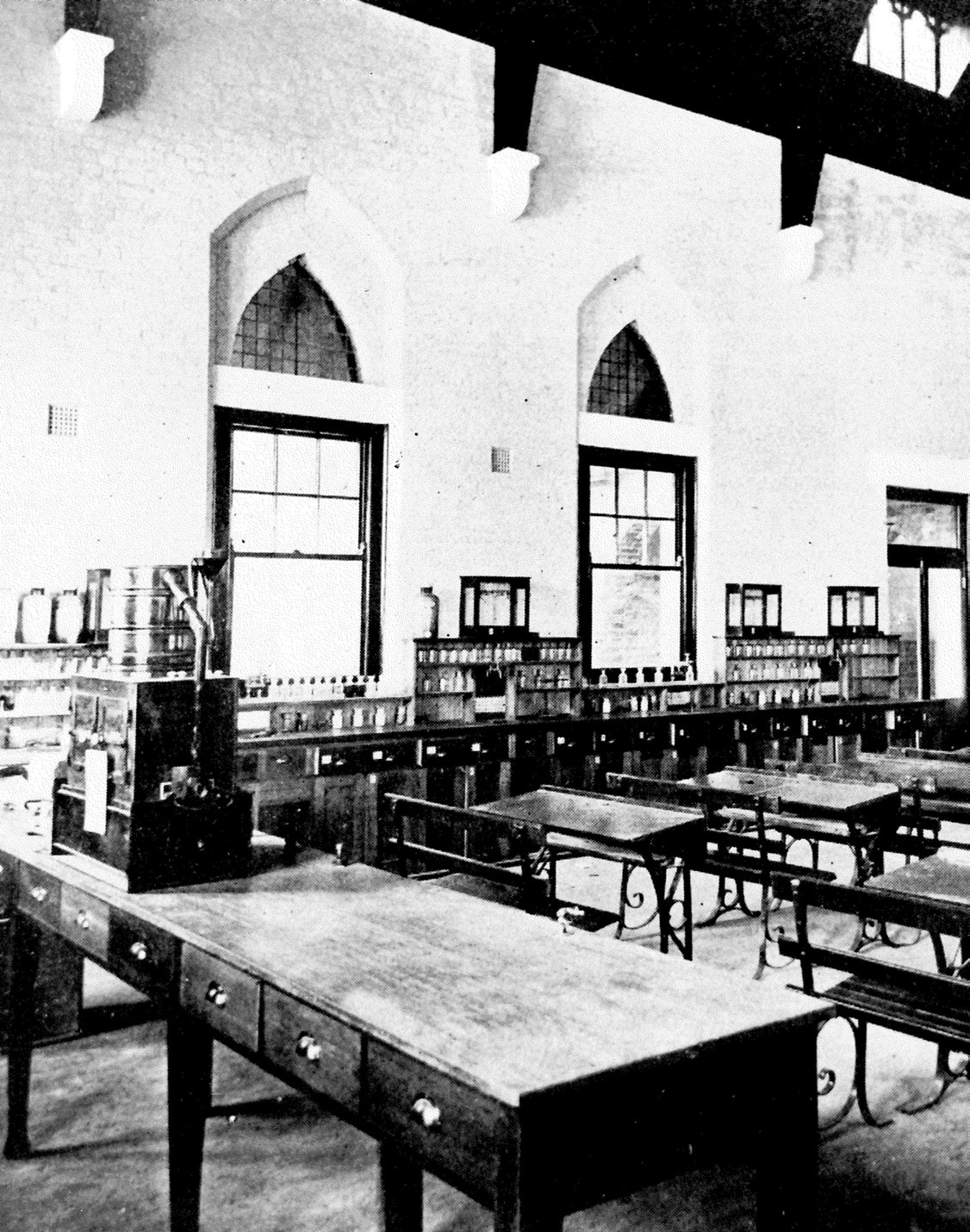
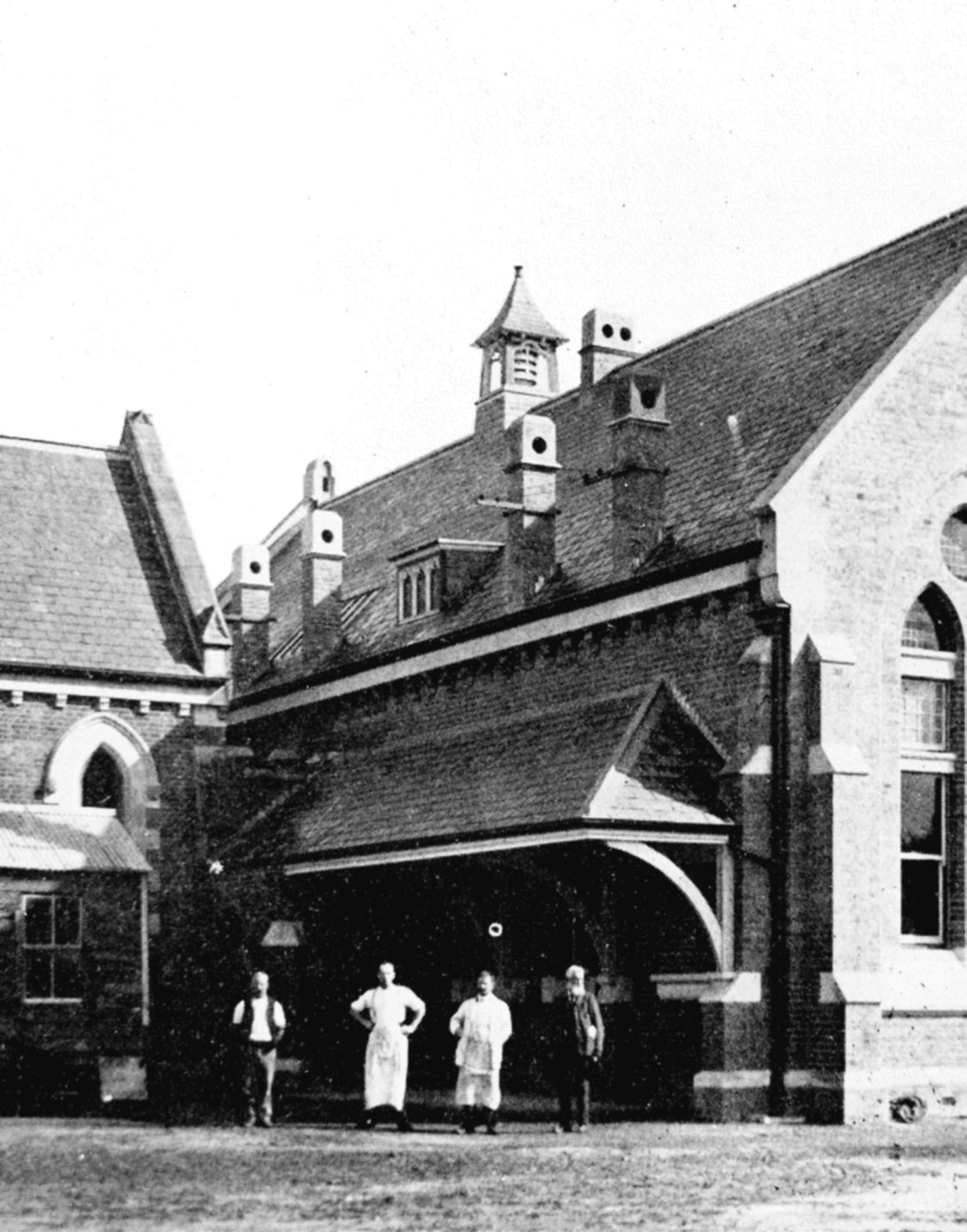
The building was originally constructed as a science wing. It was officially opened on 26 July 1912 by His Excellency Sir William MacGregor, the Governor of Queensland, when he placed the last brick in position with an inscribed silver trowel.
Sir William MacGregor said that the opening of the laboratories marked an important epoch in the history of education in Queensland and showed that the Trustees were noting advances in education elsewhere.
The new science wing was the first building to be constructed since the opening of the School on Gregory Terrace in 1881. Building costs were funded by selling endowment land and a Queensland Treasury grant.
The architect George Payne designed the science wing as a contemporary and complementary interpretation of James Cowlishaw's Gothic-inspired main building.
The science wing comprised a large chemistry laboratory and smaller physics laboratory with timber galleries. These classrooms were impressive double-storey height spaces with exposed roof structures, clerestory lighting and ventilation.
In 1928 a bellcote, designed by Arnold Brooks, and bell were erected on the wall of the building facing the Newell quadrangle. They were the gift of Old Boys in memory of George Rilatt – the School janitor and 'ringer of bells'.
The building underwent major renovations as part of the School's Centenary Building Project. It was converted into administrative offices and masters' common rooms by School architect Colin Trapp and opened in 1966.
Brisbane Grammar School Archives, no year printed · ↑ Top
The School we remember
The Great Hall
two sheets, one building
The Archives published two fact sheets on the Great Hall. Both are reproduced here in full: the first on the building and its chronology, the second on its interior and iconography.
The Great Hall
steeped in tradition
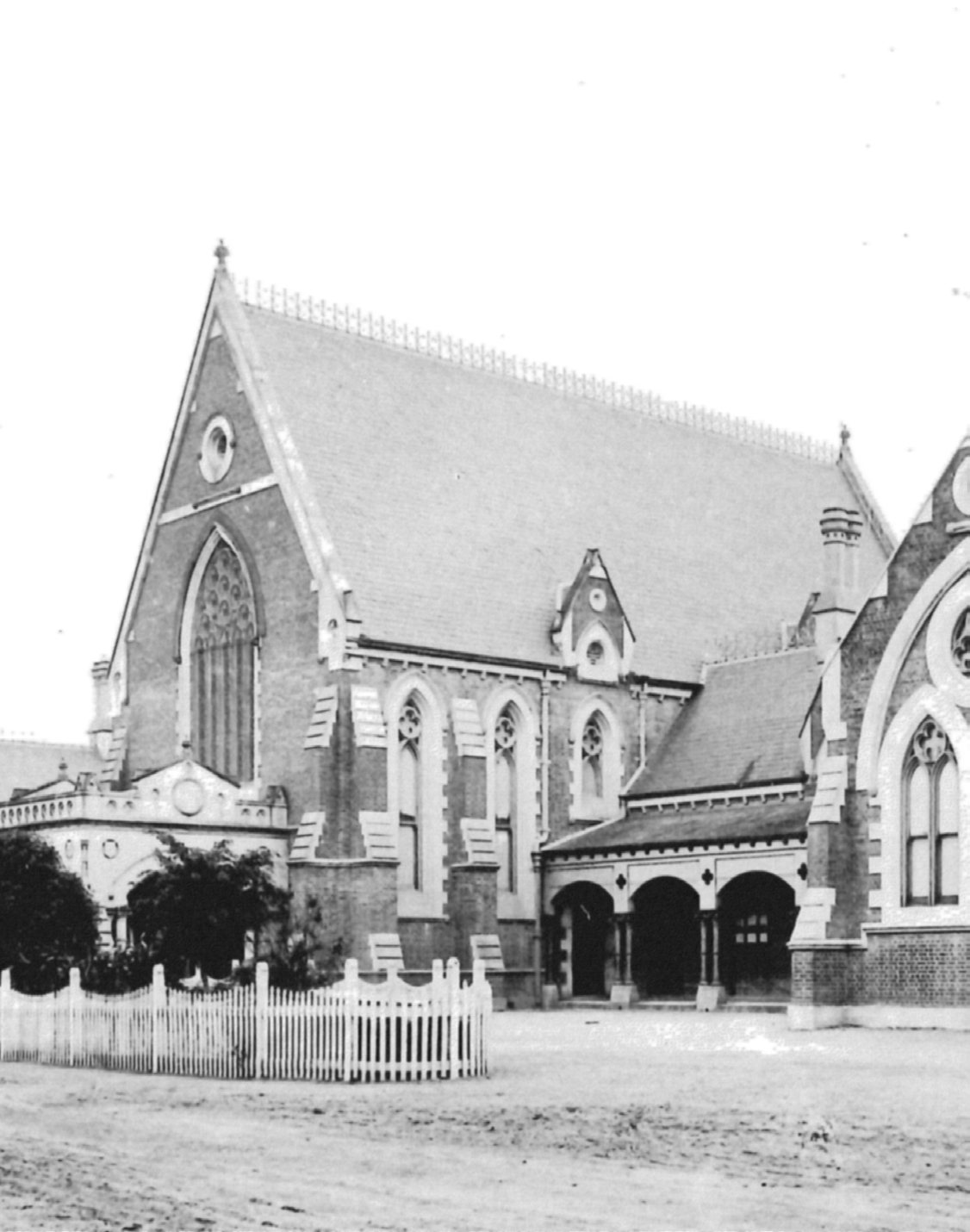
Brisbane Grammar School, 1881.From the archive
This Gothic Revival hall has been the centre of school life since first opening its doors to students in 1881.
The School, which originally opened at Roma Street in 1869, was relocated to its new hilltop position on Gregory Terrace following the expansion of the railway network.
The Chairman of Trustees the Hon Charles Lilley (later Sir Charles) laid the foundation stone on 28 November 1879 using a sterling silver trowel.
The Great Hall, with its decorative portico entrance carved from Oamaru stone, was designed by architect James Cowlishaw in 1879 and built in 1880.
The magnificent stained glass windows at the northern and southern ends of the hall showcase images of great men and honours which aimed to inspire students.
The hall was flanked by single-storey classroom wings. A second storey was added to the two wings in 1926 to accommodate more students.
It was the School's main assembly hall from early 1881 until the Centenary Hall opened in 1969 to accommodate the growing number of students.
It is the venue for many student and Old Boy functions, from musical recitals and year group assemblies to weddings and memorial services.
The Great Hall is the place students enter when they commence at the School and from where they depart at graduation.
The Great Hall stands as a symbol to the importance of education.
The Great Hall's impressive portico entry of Oamuru stone bears a number of carvings, including the foliage motifs of shamrock, holly and oak. A bust of King Alfred, the 9th century English king who promoted the value of education, sits on the outside of the central column.
The gargoyles on either side of the great cedar doors, one representing a serpent and the other a dragon, are a typical medieval feature to frighten away evil spirits.
The lofty interior is equally impressive with its exposed timber ceiling painted sky blue and dotted with gold stars.
The beautiful stained-glass windows at either end of the building, made by Ferguson and Urie of Melbourne, are thought to be the earliest Australian-produced windows in Queensland.
Both windows portray the School's ideals. The northern window shows young Queen Victoria flanked by famous men in British history – maritime and military leaders, statesmen, poets, playwrights, and men of science – looking down on the boys inviting them to 'emulate their noble deeds'. The southern window portrays the rewards bestowed by the Crown for loyalty and service.
Lining the walls are honour boards and plaques paying tribute to the war record of Old Boys as well as the distinguished service of trustees and staff.
Though now too small for assemblies, the Great Hall continues to be an integral part of the ebb and flow of life at the School since first opening to students in 1881.
Light and dark blue were originally incorporated into sporting jerseys, sports blazers and ties and later into the official School uniform.
The timeline
Year
1871
BGS Cadet Corps formed with cadets wearing blue tunics with grey trousers.
1870s
School's academic colours of red and gold introduced by the first Headmaster Thomas Harlin, reflecting the academic colours of Cambridge University.
1887
First honour cap awarded by the vote of the football team to the best back, best forward and next best player.
1880s -1890
Second Headmaster Reginald Heber Roe introduced the School's sporting colours to reflect the dark blue of Oxford University where he was a scholar, and the light blue of Cambridge University where the first Headmaster Thomas Harlin was a scholar - these colours are now part of the School uniform.
1890
Cadets started to wear khaki uniforms.
1903
School badge introduced.
1910
Hatband introduced but later lapsed.
1912
First reference to sports Colours.
1919
Rules for Colour awards detailed criteria for awarding Full Colours and Half Colours.
1929
Revival of the boater hat.
1930s
School tie optional with boys wearing various neck and bow ties up to this time.
1938
BGS Rifles formed to replace artillery unit with a new uniform comprising thick khaki shirt, with epaulettes showing School colours, and military shorts, with slouch hat replacing the helmet.
1948
Official School uniform introduced.
1955
New School uniform introduced which included pale blue shirt, a standardised BGS tie and a hat band with diagonal stripes that resembled the stripes on the tie.
1957
New School uniform, including School tie becomes compulsory. First Old Boys' tie approved.
1960
School uniform changed with introduction of suits and white shirts in winter term instead of blue shirts and pullovers.
1964
Shorts introduced for boys in Form II and trousers for all other boys.
2018
Colours Constitution: Sports pockets on blazers - Full Colours on left-hand side of blazer; Sports awards on blazers – shown on right-hand side of blazer.
The 1871 and 1870s entries appear in that order on the display.
The objects and photographs on display
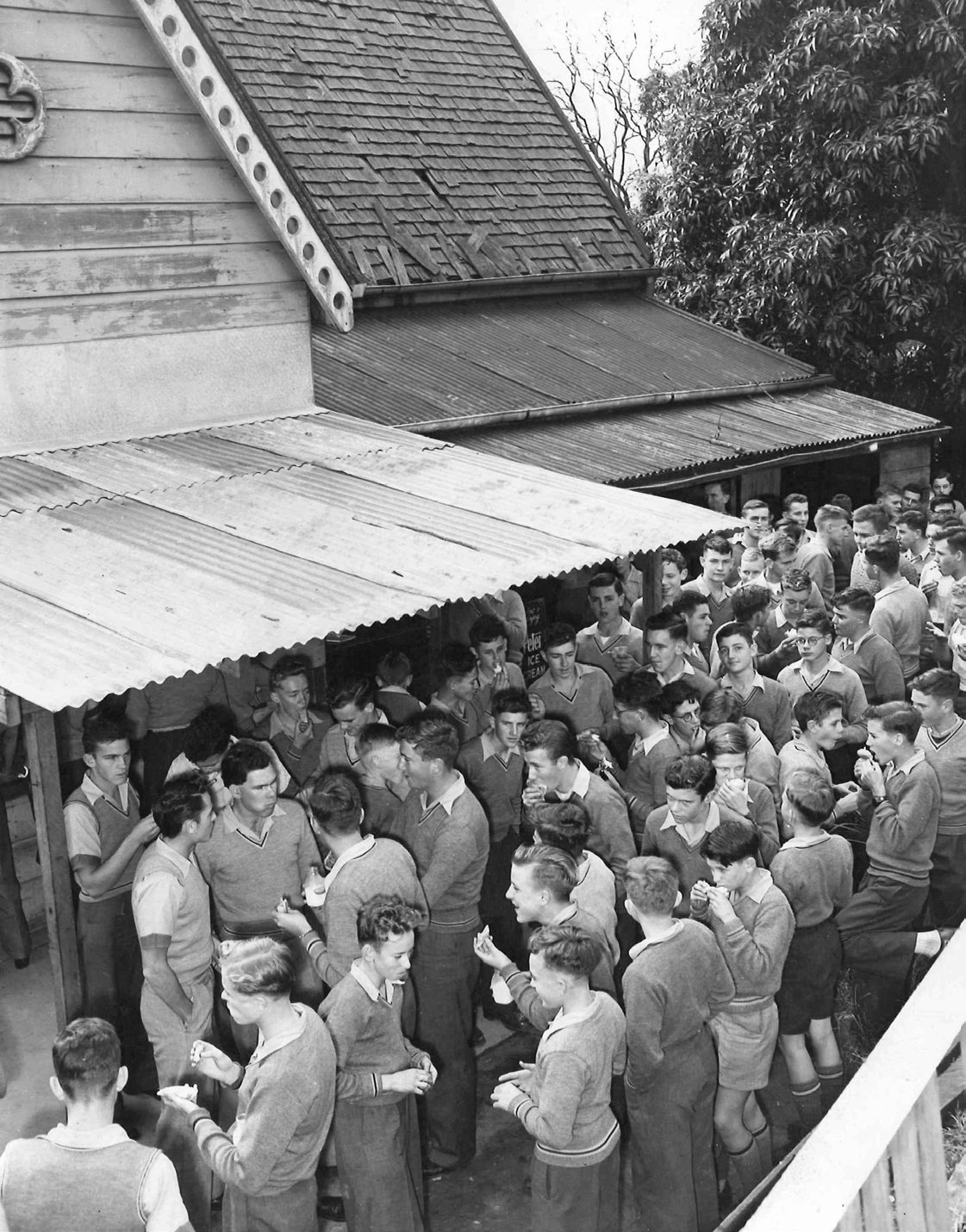
Rugby honour cap winners, 1916 · School magazine committee, 1989 · School boater belonging to Fred Hopp (BGS 1928-1930) · Boys at School tuckshop, 1954 · Rugby game, 1915 · Rugby honour cap winners, 1914 · Fencing practice, 1912 · Rowing crew, 1909 · Empire Cup team, 1903 · Captains & vice captains of cricket teams, 1913 · Otto Nothling, (BGS 1914-19) Vice Captain of 1st XI in 1918 · Old Boys' tie · Football team, c.1880 · Rugby honour cap awarded in 1909-10 to Norman Austin Lloyd (BGS 1905-1910) · BGS Sydney tour, 1914 · Prefects and School committee, 1914 · BGS rowing crew, 1914 · Honour cap winners, 1915 · 1st XI vs Nudgee, 1915 · Tennis pocket awarded to John Wright Blaiklock (1924-1928) · Hat band, c1929 · Hat band, 1936 · Form IV Grammar boys, 1914 · Gymnastic squad pyramid, 1907 · Life saving team and winners of Wallace Bishop shield and premiership, 1935 · BGS vs Toowoomba Grammar School, 1915 · Junior debaters, 1967 · Second Master Harry Newell shows boys fob watch awarded in 1870 to F.B.G. Sheridan, c1955 · Second Master, 'Shon' Mason and class, c1950 · Foundation Day Regatta, 1940 · Grammar boys next to the Gun, 1945 · Cricket pocket awarded to Charles Roe (BGS 1932-1936) · Football pocket awarded to Fitzgerald Roxburgh Vincent (BGS 1924-1929) · Form VI B, 1943 · Centenary March, Foundation Day, 1968 · Football pocket awarded to John Bertram Gilchrist Gibson (BGS 1918-1923) · Rugby honour cap awarded in 1911 to Leslie Gall (BGS 1910-12) · Bryan Hoskin, Gervase Fullerton and "Bush" Brown (R.Brown) · Some members of Cricket 1st XI in 1947
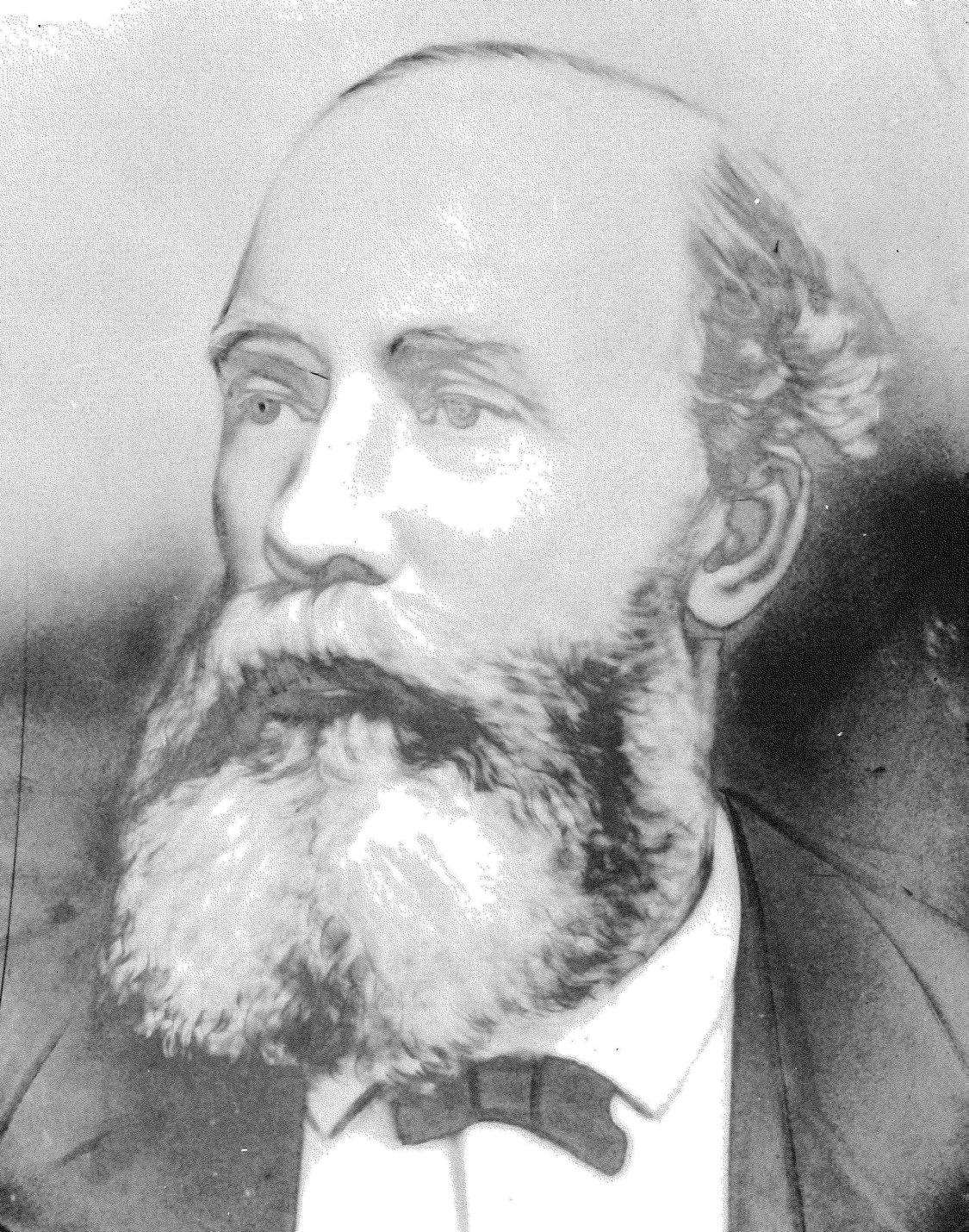
Sir Charles Lilley, journalist, politician and judge, was unwavering in his vision and efforts for a comprehensive system of free education in Queensland during the 41 years he lived in the colony.
As early as 1859 Lilley campaigned to establish a School of Arts to promote adult education and became the first president of the Queensland Liberal Association.
His brilliant oratory skills made him a persuasive force in parliament and on the bench. He was MLA for Fortitude Valley from 1860-1874, and earned the nickname 'Lilley of the Valley'. The Federal Seat of Lilley was named after him. He held many cabinet positions during his political career, including that of Attorney-General. Lilley was Premier from 1868-1870.
When he resigned from politics in 1874 he became Judge of the Supreme Court of Queensland, then Queensland's second Chief Justice from 1879-1893. Lilley was knighted in 1881.
Championing liberal and sometimes radical views, Lilley used his political influence to embrace many causes, particularly education. As Premier he abolished school fees, making Queensland the first colony to introduce free primary education in 1870. He was hailed by many as the real father of Queensland's system of free, compulsory and secular education.
From 1874-1875 Lilley chaired a royal commission on the working of the colony's educational institutions. His report provided the basis of the State Education Act 1875 which launched a modern system of education in Queensland.
In 1891 he chaired a royal commission to establish a university in Queensland, reflecting his long held support for tertiary education. However, he did not live to see the university founded in 1909.
In paying tribute to Sir Charles Lilley, who died on 20 August 1897, Headmaster Reginald Heber Roe said that Lilley 'believed with all his heart in the necessity for higher education, both as a means of raising the standard of thoughtfulness and refinement in our homes, and as an instrument for the scientific development of the material resources of our country'.
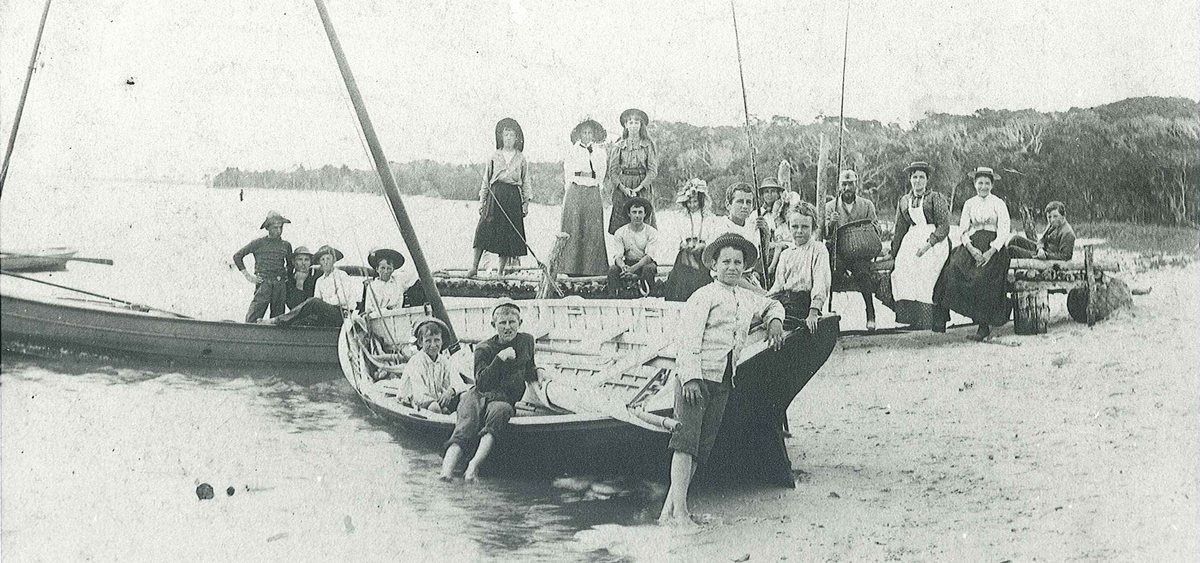
Headmaster R.H. Roe and his wife, Maud (back row 4th and 3rd from right) with a boating party near Kamp Roe, circa 1890.From the archive
Brisbane Grammar School's first camp, established by the early 1880s on South Stradbroke Island by Headmaster Reginald Heber Roe, proved to be a trailblazer for outdoor education training in Australia.
Although several early Australian schools provided 'Saturday rambles', Roe's Kamp was reputed to be the first to establish the principle of outdoor living and camping as an educational principle in Australia.
The idea for a school camp came after Roe went on a camping trip to the island with W.E. Box and Captain Whish and his family in 1878.
The three friends subsequently purchased adjacent blocks of land in 1882 at the southern end of the island and a camp was established on Roe's 11-acre block which they called Whirobo, an acronym of their names.
In 1885, the first hut was built of galvanised iron and served as a store for tents, tools and utensils, and as a sheltered kitchen and emergency living quarters during bad weather.
At some stage after 1890 Whirobo Camp was renamed Roe's Kamp, the spelling meant to convey mischievous humour and perhaps signal its humble establishment in a setting not grand enough to be formally designated as a 'Camp'.
The Skipper, as Reginald Heber was universally known, and his wife Maud, Captain Whish's daughter, took boarders from Grammar's School House for regular holidays and excursions to Roe's Kamp.
On many occasions there would be several dozen boys together with members of the extended Roe and Whish families.
The camp reflected Roe's philosophical commitment to ensuring that an academic education be integrated into all-round development. Here the boys were able to enjoy communal living and comradeship far removed from the classroom environment.
Days were spent, exploring, hunting, fishing, swimming, sailing and canoeing and at night the boys would read and play games until bedtimes, sometimes preceded by furious battles in the dark using sugar bags stuffed with soft material.
Roe's Camp was almost swallowed up by the sea in 1938, despite the installation of trenches and walls. It was subsequently dismantled and relocated further north at Picnic Point.
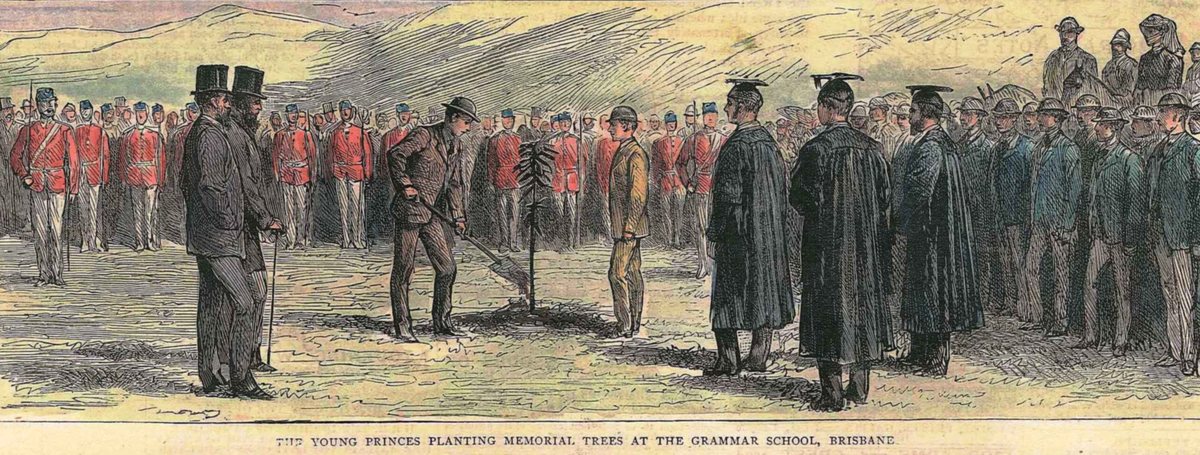
Hand coloured, wood engraving of the young princes at a Brisbane Grammar School tree planting ceremony on 19 August 1881, published in The Graphic, 3 December 1881, page 573.From the archive
Four occasions spanning over 100 years in the School's history have been marked by royal visits.
The first royal visit took place on Saturday 29 February 1868 when the third son of Queen Victoria, HRH Prince Alfred – later Duke of Edinburgh – laid the foundation stone of the original School at Roma Street in front of a guard of honour and hundreds of spectators.
Though the School was originally to be named after Prince Albert, the event was commemorated in the present School with his coat-of-arms included in the northern stained-glass window of the Great Hall.
Twelve years later the two eldest sons of the future King Edward VII (the eldest son of Queen Victoria) toured Australia while serving as midshipmen on HMS Bacchante.
While in Brisbane Prince Albert, (often referred to as Edward, one of his middle names) and his younger brother, Prince George (later King George V) visited the new School on Gregory Terrace on Friday 19 August 1881.
They each planted a Moreton Bay Fig tree in the School grounds to commemorate their visit to the colony. In their address to the assembled visitors, staff, boys and girls from both Grammar Schools, they referred to their uncle's earlier visit in 1868 and his association with the foundation of the School.
After visiting the Great Hall the princes handed the Headmaster, Reginald Heber Roe, their letter of appreciation to the boys of the School stating, that while in Sydney, they had 'heard of those of your schoolmates who had achieved distinction in the university examination there'.
Some 87 years later Prince Philip, the Duke of Edinburgh, visited the School during its centenary celebrations while in Australia for the Commonwealth Study Conference.
On 27 May 1968 Prince Philip planted a Queensland Hoop Pine tree on the lawn between the two trees planted by the two princes some 80 years earlier and then addressed an assembly of nearly 4,000 people on the School oval.
On Thursday 10 March 1977 Prince Philip returned to the School to present the Duke of Edinburgh Awards in the School's Centenary Hall. The community of staff and students, including pupils from Brisbane Girls Grammar School, turned out in force to greet him.
Prince Philip expressed his pleasure to have been able to visit the School again and was particularly gratified to note the number of young people participating in the Duke of Edinburg Scheme.
The three trees planted by members of the royal family now form part of a triangle of trees flanking the boarders' lawn in front of the Roe Building. They are part of the School's historic fabric and have become familiar landmarks to generations of students.
Brisbane Grammar School is governed by a Board of Trustees – the School's supreme administering body with wide ranging responsibilities governing its management and growth.
The role of the Trustees was defined in the Grammar Schools Act 1860. The Act stated that learning was to be encouraged by establishing public grammar schools to provide 'all classes and denominations' of residents in the Colony of Queensland with 'the advantages of a regular and liberal course of education'.
This Queensland legislation was unique in Australia at that time and theoretically provided a mechanism for developing a framework for an education system from primary to secondary school to university.
Any municipality in Queensland in which £1,000 had been privately subscribed for establishing a grammar school became entitled to claim from the Government a grant of £2,000 and an annual endowment of £500 per annum. By an amendment of the Act in 1864 the annual endowment was increased to £1,000 on certain conditions.
The Brisbane Grammar School Board of Trustees was to comprise four members appointed by the Government in Council and three elected by subscribers or donors to the School. The Queensland Government representatives on the first Brisbane Grammar Board of Trustees, elected on 18 October 1867, included the Hon T.B. Stephens (Chairman), Hon Charles Lilley, Dr K. I. O'Doherty and A.B. Pritchard. The subscribers, elected on 20 September 1868, included L.A. Bernays, W. Brookes (Treasurer) and R. Macdonnell.
The Corporation of the Trustees of Brisbane Grammar School was thus constituted and the election and appointment of the trustees was originally on a triennial basis. Now the trustees hold office for four years and at the end of that time are eligible for re-election or re-appointment.
Brisbane Grammar School was one of eight Queensland grammar schools established under the 1860 Act during the 1800s. In 2000 these schools established the Queensland Grammar Schools Association.
The School opened on 1 February 1869 and was Brisbane's first boys' secondary school and second in Queensland after Ipswich Grammar School.
The role of the Trustees, who work on a voluntary basis, includes determining the strategic direction of the School; appointing the Headmaster; ensuring that students, their welfare and development remain the central focus of the School in all its activities; working with the Headmaster, staff and school community to promote and implement the School's mission and values; approving and monitoring policies and practices relating to optimal human resource management within the School; ensuring appropriate review processes are in place to monitor and enhancing the quality of all school activities; assuming financial responsibility and accountability; and reviewing governance policies and performance of the Board of Trustees.
Expenditure is recouped by income from government endowments and by fees paid for the pupils. On occasions revenue is obtained by appeals to Old Boys, parents and friends, and public-spirited community members. Donors to the School appeals are still the only people who are eligible to vote for Trustees.
The Board of Trustees has been represented by many fields of community endeavour over the years, including Rhodes scholars, from the legislature, judiciary and the law, to medicine, science, the services and business.
Inaugural Trustees included Chairman, Sir Charles Lilley, Chief Justice of Queensland. He was an advocate for higher education and initiated the gold and silver Lilley Medals. Other Trustees at that time included Dr Kevin O'Doherty, responsible for Queensland's first health act and Lewis Adolphus Bernays, the first Clerk of the Queensland Legislative Assembly and founder of the Queensland Acclimatization Society.
One of the most illustrious Chairman of Trustees was Sir Samuel Griffith, Chief Justice and Premier. He was a principal author of the Constitution of Australia and became the first Chief Justice of the High Court of Australia.
From the laying of the foundation stone of the original Brisbane Grammar School on 29 February 1868 to the present day, the Board of Trustees has steered the School through changing economic and political times to ensure the values enshrined in the Grammar Schools Act 1860 are maintained.
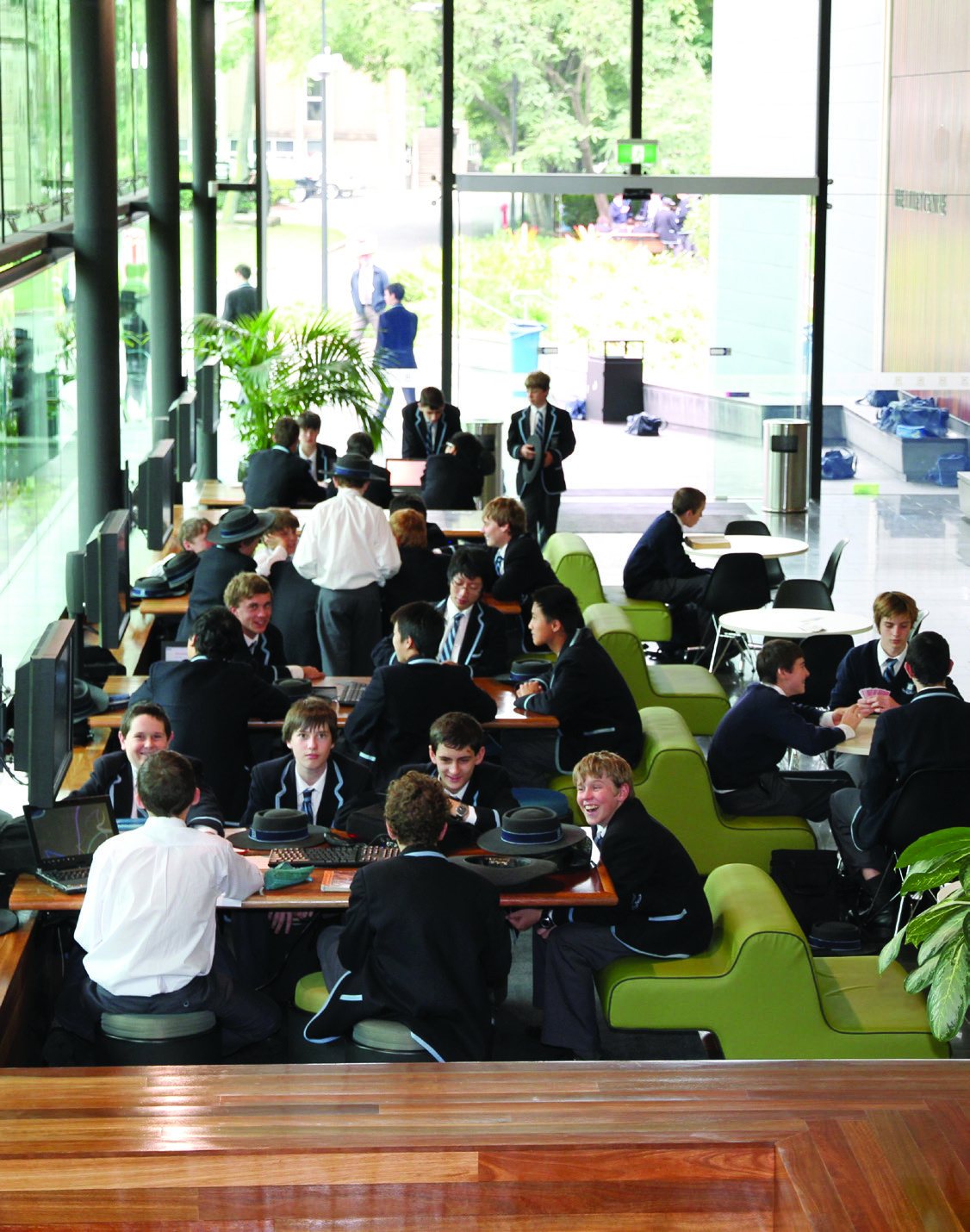
When the internationally-recognised Lilley Centre opened on 26 February 2010, it ushered in new styles of teaching and learning based on flexible and technologically-enhanced learning spaces.
The Lilley Centre was named after Sir Charles Lilley – one of the founding fathers of Brisbane Grammar School.
Lilley was one of the pioneers of formal education in Queensland, and Brisbane in particular. He participated in the framing of the Grammar Schools Act 1860 which was passed by the new government following Queensland's separation from New South Wales in 1859. This legislation aimed to provide boys and girls with the opportunity for secondary and further education.
In 1867 Lilley was appointed one of four Queensland Government representatives to the first Brisbane Grammar School Board of Trustees. His generous financial support was instrumental in building the original School in Roma Street in 1868. It was the first boys' secondary school in Brisbane and second oldest in Queensland.
At the School's opening ceremony on 1 February 1869 Lilley, then Premier of Queensland, announced his intention to initiate gold and silver medals that still bear his name. These are the School's most prestigious awards and are awarded to the Dux of the School and the Dux of Year 10.
As Chairman of the Board of Trustees from 1877 to 1887, Lilley presided over one of the most productive decades of the School's growth, focusing on an ambitious program to relocate the School from Roma Street to Gregory Terrace.
Lilley laid the foundation stone for the main school building, comprising the Great Hall and classroom wings, which opened in 1881. He also oversaw the construction of School House, designed by Richard Gailey, to accommodate the boarders and Headmaster's living quarters, which opened in 1887.
It was his vision to provide girls with the same educational opportunities as boys that led to the establishment of Brisbane Girls Grammar School in 1875.
The Lilley Centre – acknowledged globally as an exemplary educational facility by the OECD Centre for Effective Learning Environments in 2011 – continues the School's distinguished tradition of innovative teaching and learning championed by visionaries such as Sir Charles Lilley.
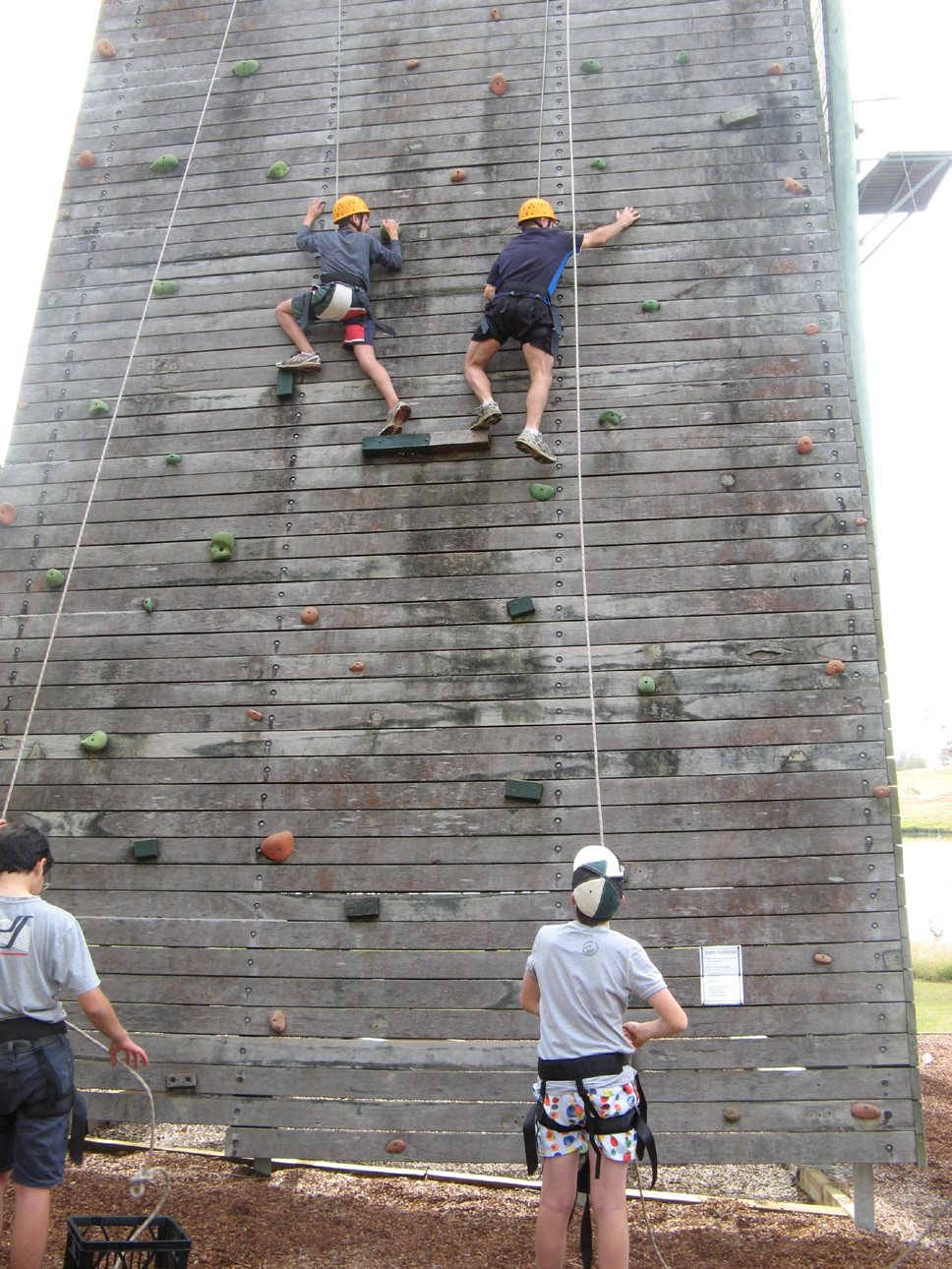
Students scaling the climbing frame, 2013.From the archive
A new camp was established near Lake Moogerah by headmaster Max Howell in 1976 which reflected the philosophy espoused nearly a century earlier by Reginald Heber Roe, that outdoor living should be integral to a student's education.
This purpose-built centre at Pepperina Hill was officially opened by the Governor of Queensland, Air Marshall Sir Colin Hannah on 30 May 1976.
The camp project was driven by a dedicated team in the Parents and Friends' Association which oversaw the acquisition of a suitable site on a long lease from the Irrigation and Water Supply Commission.
Initially the outdoor education centre consisted of the main kitchen, dining room, dormitory building, boatshed and accommodation for staff which made it possible to run regular class excursions.
An astronomical observatory was built in 1982 with improvements four years later to make it easier to track stellar objects. Expansion of activities also included a ropes course and climbing tower.
Today, the School sends each form class from Years 8, 9 and 10 to the Moogerah Outdoor Education Centre to strengthen intra-class relationships and morale, as well as develop team-building and leadership skills.
Year 6 and 7 students visit the camp for a shorter period each year. Form Seniors also attend the camp in their mentoring role with younger students.
The five-day program includes rock-climbing, bushwalking, orienteering, canoeing as well as a camp-out in the bush at the foot of one of the nearby mountains.
Moogerah is also used for writers' camps, composers' camps, scientist-in-residence camps, and Inter-School Christian Fellowship camps. It is also used for other activities such as sports training, astronomy, sky viewings and fieldwork in senior courses.
Constant updating of facilities and courses, coupled with the dedication and enthusiasm of the Grammar community will ensure the experiential-based program remains relevant for a broad and fulfilling education at the School.
The Parents and Friends' Association is the ultimate cooperative through which parents and friends channel their voluntary services for the benefit of the whole school community.
The Parents and Friends' (P & F) Association has been the umbrella organisation for coordinating the School's support groups since 1972.
The P&F Association provides the administrative framework for these groups which undertake numerous extra-curricular activities to raise funds for the School where needed.
Each group has its own management body, with group presidents reporting to the P & F Association Management Committee every term.
The oldest of these support groups is the P & F Auxiliary. It evolved shortly after the Second World War when a small group of mothers formed a ladies' committee to supply School lunches and make donations to the headmaster's amenities fund.
Since that time, and with the continued support of the School and parents, the Auxiliary has grown into the large organisation that it is today. One of its core activities is administering and staffing the Brisbane Grammar School Shop (uniforms, books and stationery) and Tuckshop.
Over the years the Auxiliary has provided funding assistance to refurbish and construct School buildings and amenities. It has contributed major donations to the Centenary Building Fund with more than $3.5 million towards the Lilley Centre, Arts Centre, M.A. Howell Sports Centre and Centenary Courtyard redevelopment.
A memorable gesture by the Auxiliary has been its funding of the Great Hall's beautiful Millennium Window depicting a boy's journey through Brisbane Grammar School.
The Auxiliary contributes in many ways to the social and cultural life of the School by providing support for key school events and organising functions for the parent community. It offers a way for parents to meet, make life-long friends and be involved in their sons' careers at the School, with the opportunity for continued interaction through the Parents of Past Student groups.
The volunteer support of parents is as invaluable today as it was in the early days. Their active participation in the life of the School is one of the most significant factors in promoting the wellbeing of the students.
In 2011 the Auxiliary committee developed its motto, Connect-Care-Contribute. These words embody the vital functions that this support group has given to the school community since its inception.
The commitment of the P&F Auxiliary through its services and funding contributions continues to enhance the welfare of every student on his journey through Brisbane Grammar School.
A note on names. This fact sheet was published by the Brisbane Grammar School Archives in 2014 and is reproduced here as it was written. It refers to the M.A. Howell Sports Centre. That building is now the Indoor Sports Centre. The sheet has not been altered.
About this pageEvery fact sheet above is reproduced word for word as the Brisbane Grammar School Archives published it, between 2014 and 2017. Spellings, punctuation and any errors are the Archives' own; nothing has been corrected, shortened or rewritten. Photographs are reproduced from the fact sheets themselves. Where a building has since been renamed, a dated note appears beneath the sheet and the sheet itself is left as written.
Nil Sine Labore
Brisbane Grammar School Old Boys' Association · Old Boys History. Part of the OBA Knowledge Project.
Draft site for committee review. Spot an error or hold a missing piece? Tell the OBA